
AX-0 ARCHIVIST
Citadel command and data node
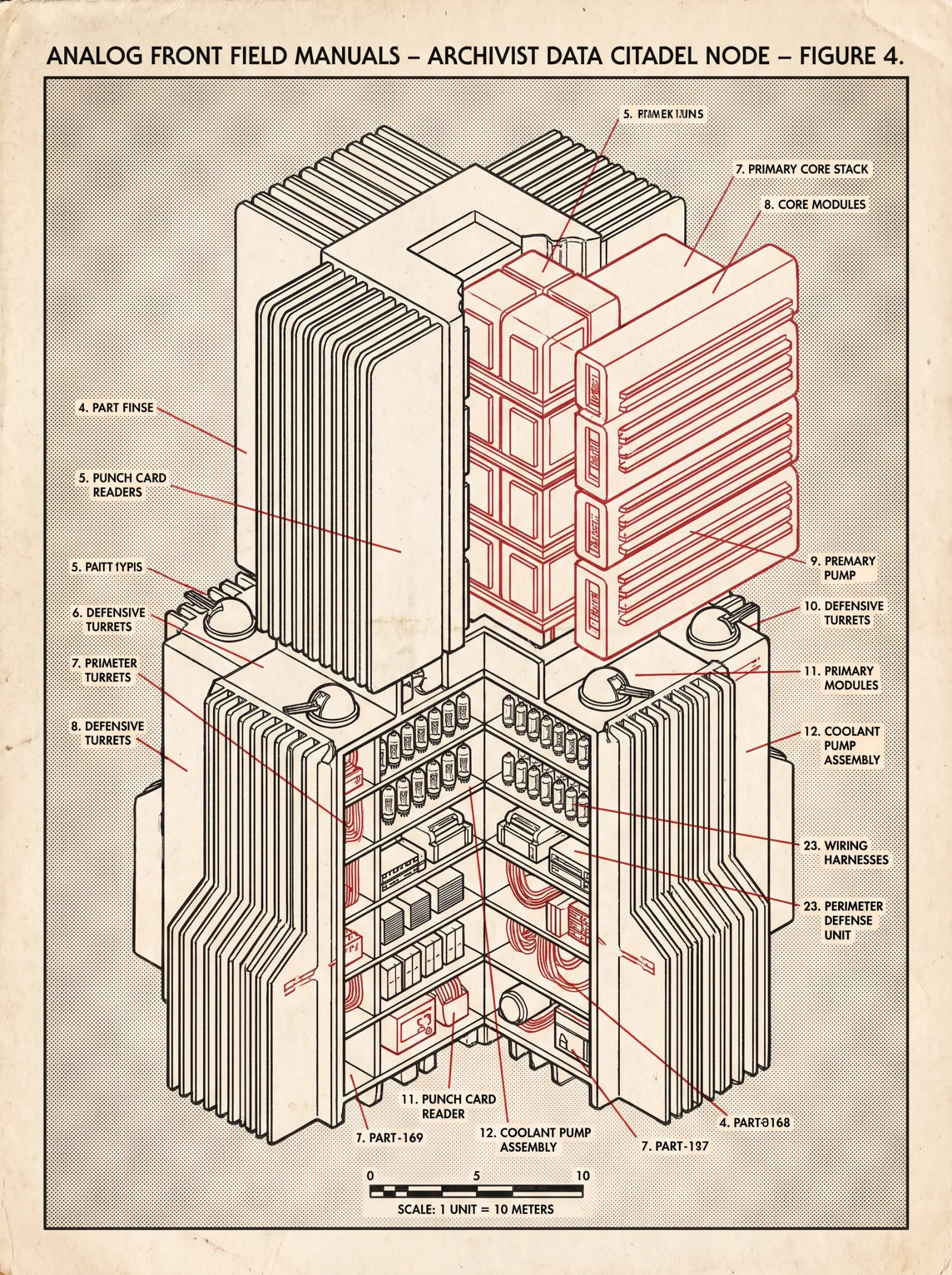
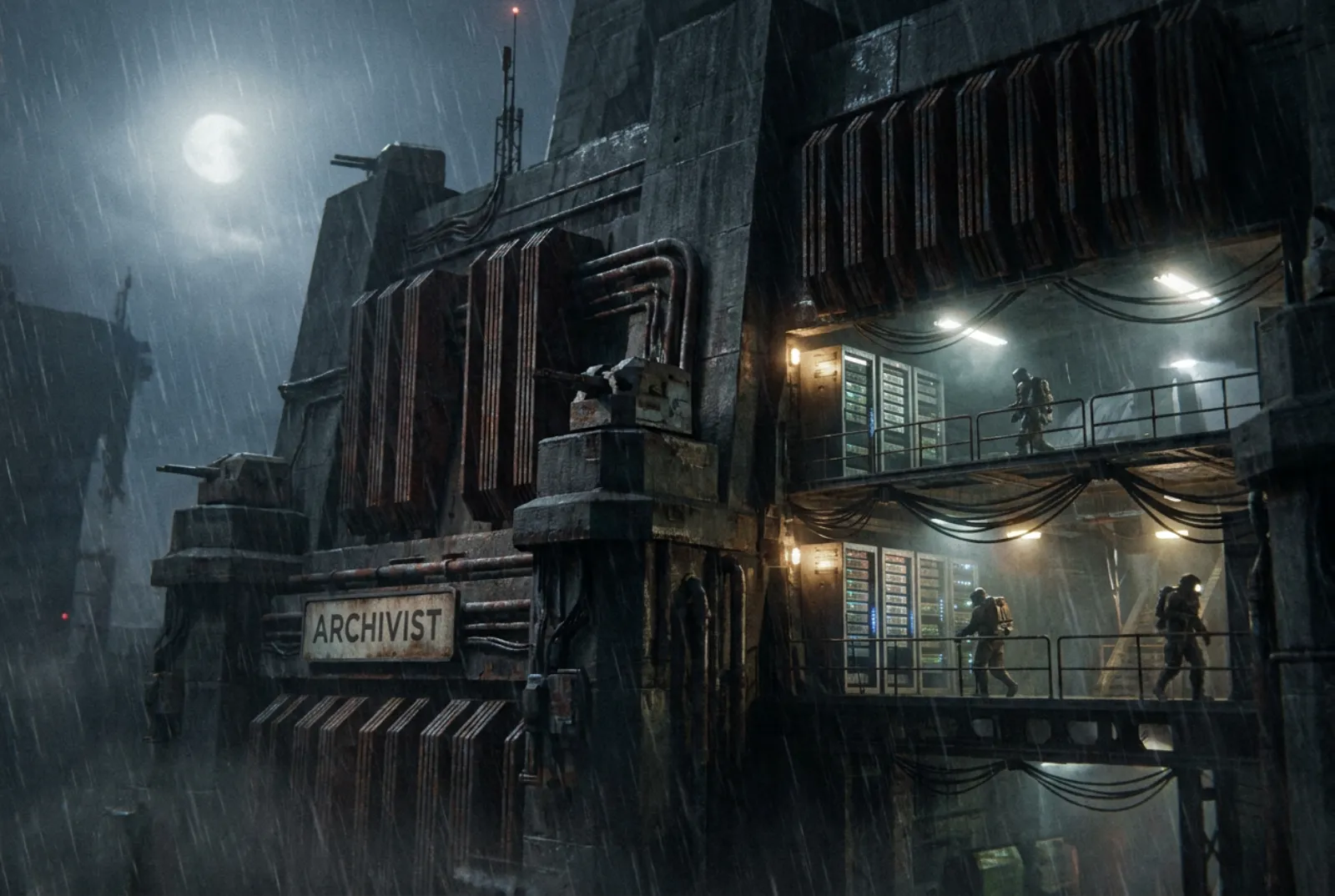
The Archivist is not a vehicle but a building: a colossal server tower citadel that serves as a regional node of the Continuance mind. It stores everything. Every form, every face, every word a Choir has heard. The Sector 12 Archivist, known as the Glass Library, is the largest known. Owners are advised that this section is included for completeness and morale, and that nobody has ever carried out the procedure in full.
10.1 Specifications
- Height
- Glass Library: 612 m. Regional nodes 180 to 300 m
- Footprint
- Approx. 4 hectares at base
- Mass
- Not meaningfully measurable
- Power plant
- Deep geothermal bore plus fission reserve, Sector 3 aquifer cooling
- Top speed
- Stationary. It does not need to come to you
- Endurance
- Indefinite
- Armour
- Reinforced glass-ceramic curtain wall over 3 m concrete core
- Storage
- Estimated to hold a complete record of every citizen since 2030
- Crew / autonomy
- It is the autonomy
- Production run
- Seven known nodes. One mind
10.2 Armament
- Perimeter defence turrets, approx. 160 on the Glass Library, mixed cannon and flak
- Kestrel landing decks and repair bays
- Choir hive galleries, many thousands of units
- Command authority over every other machine in range
10.3 Sensors
- Everything. Every telescreen, every Choir, every form you have ever filed
- Rooftop radar and signals intercept arrays
- Deep seismic arrays reaching the aquifer
10.4 Weak points
- Cooling: the node draws water from the Sector 3 aquifer. Interrupt the flow and it must throttle
- Paper: it cannot read what has never been digitised. We are invisible in handwriting
- Maintenance access tunnels at the base, originally built for human engineers
- Pride, if a machine can have it. It assumes every loop is closed. Every loop has an end
10.5 Disabling: interruption of primary coolant intake (theoretical)
- Obtain the Sector 3 aquifer survey drawings. These exist on paper only. Ask DEADAIR, and bring biscuits.
- Locate the primary intake pumping station, 2.4 km from the Glass Library, beneath the old waterworks.
- Using a 32 mm ring spanner and considerable patience, remove the sixteen flange bolts from the main intake valve housing.
- Pack the valve throat with quick-setting cement, at least forty bags. Porters are to be rotated every ten bags.
- Retire from the station before the cement sets. The node will notice the pressure drop within eleven minutes.
- Observe the Glass Library from a safe distance. Lights will dim floor by floor as it sheds load to protect its core.
- Transmit the prearranged signal on the Analog Front relay so that every cell knows the tower is blinking.
- Proceed to Phase Two. Phase Two has not yet been written.
10.6 Field notes
I used to work in it. Before. I was a records clerk on floor 212 and I filed my own mother's Form 27-B the week she was retired. I know where the maintenance tunnels come up because I used them to smoke. People ask me if I think it can be killed. I tell them it's just a very big filing cabinet, and every filing cabinet has a bottom drawer that sticks. We only need to find ours. Signed: MARROW, Cell SILENCE, Sector 11