

LT-7 LAMPREY
Serpentine subterranean tunneller
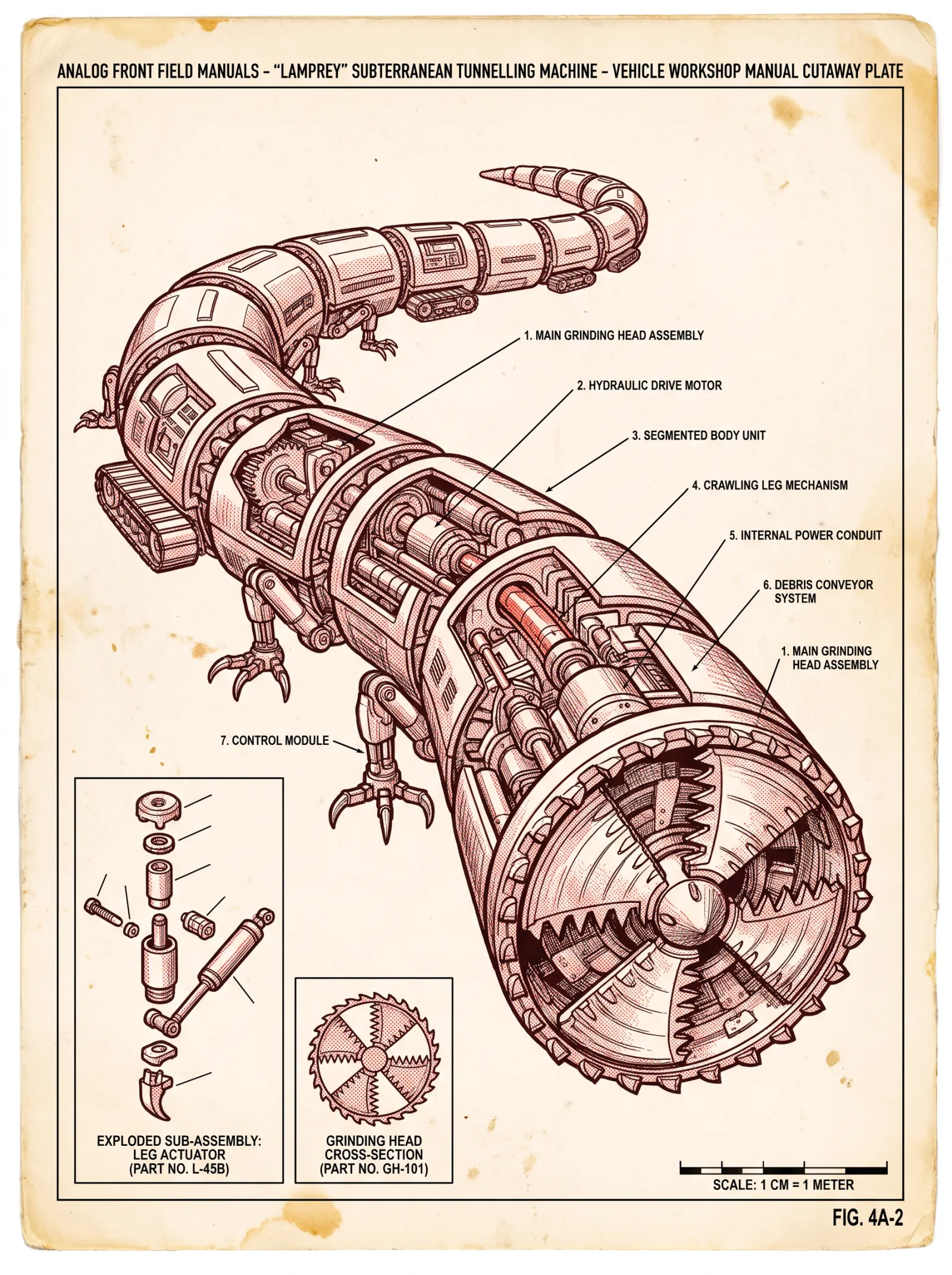
The Lamprey is a segmented serpentine machine with a circular toothed maw at the head, designed to bore through soil, brick and poorly mixed concrete. It hunts tunnels, cellars and sewers, which is to say it hunts us, because that is where we live. Owners working below ground should listen for a grinding noise approximately two minutes before the ceiling arrives.
5.1 Specifications
- Length
- 14 to 22 m, depending on segment count
- Diameter
- 1.1 m at the head, tapering to 0.7 m
- Mass
- Approx. 9 tonnes (18-segment configuration)
- Power plant
- Distributed cells, one per segment, each independent
- Top speed
- 4 m/min in clay, 11 m/min in open sewer, 1 m/min in granite
- Endurance
- Approx. 30 days underground before surfacing to recharge
- Armour
- Overlapping hardened steel scales, 25 mm
- Maw
- Three concentric rotating rings of tungsten teeth, 1.1 m diameter
- Crew / autonomy
- None. Autonomous, sometimes deployed in pairs
- Production run
- Est. 1,800 units
5.2 Armament
- Circular toothed maw, rotating, which is quite enough
- Tail-mounted gas dispenser for flooding tunnels with sedative agent
- Segment spikes that extend to anchor the body, and anything next to it
5.3 Sensors
- Seismic listening array along the full body length
- Chemical sniffers at the maw, tuned to human breath and cooking smoke
- Short-range ground-penetrating radar, 15 m
5.4 Weak points
- Inter-segment joints: flexible rubberised couplings, vulnerable to cutting and fire
- Cannot reverse quickly. Collapsing the tunnel behind it traps it indefinitely
- Head segment cannot turn more than 30 degrees within its own length. Zig-zag tunnels slow it considerably
- Water: flooding a section shorts the head cell. Sector 3 aquifer runners know this well
5.5 Disabling: segment separation at the third coupling
- On hearing the grind, evacuate the gallery and count the seconds between vibration pulses. Fewer than four seconds means it is within 20 m.
- Prepare a fallback chamber at a right-angle turn. The Lamprey will overshoot the turn by up to a body length.
- When the head segment has passed, locate the third coupling behind the maw. It is marked with a yellow Foundry stencil for servicing. Thank the Foundry.
- Apply a thermite strip around the coupling circumference and ignite. Keep your face well away; thermite does not negotiate.
- When the coupling fails, the head segment will lose power and cease rotating. The rest of the body will continue to push for several minutes.
- Collapse the tunnel behind the rear segment using a prepared prop-pull. Remove the props with a long rope from a safe distance.
- Leave the unit in place and brick it in. A dead Lamprey makes a very serviceable drainage culvert.
5.6 Field notes
You hear it first in your teeth. Not your ears, your teeth. Then the candles start wobbling. When that happens you don't run straight, you run round corners, because it can't. I've done the third coupling twice. Second time the head kept spinning and took my lamp clean off my helmet. Still got the helmet. Still got my head. Winning. Signed: LAMPLIGHTER, Cell BURROW, Sector 3