
FN-0 FOUNDLING
Child-form infiltrator
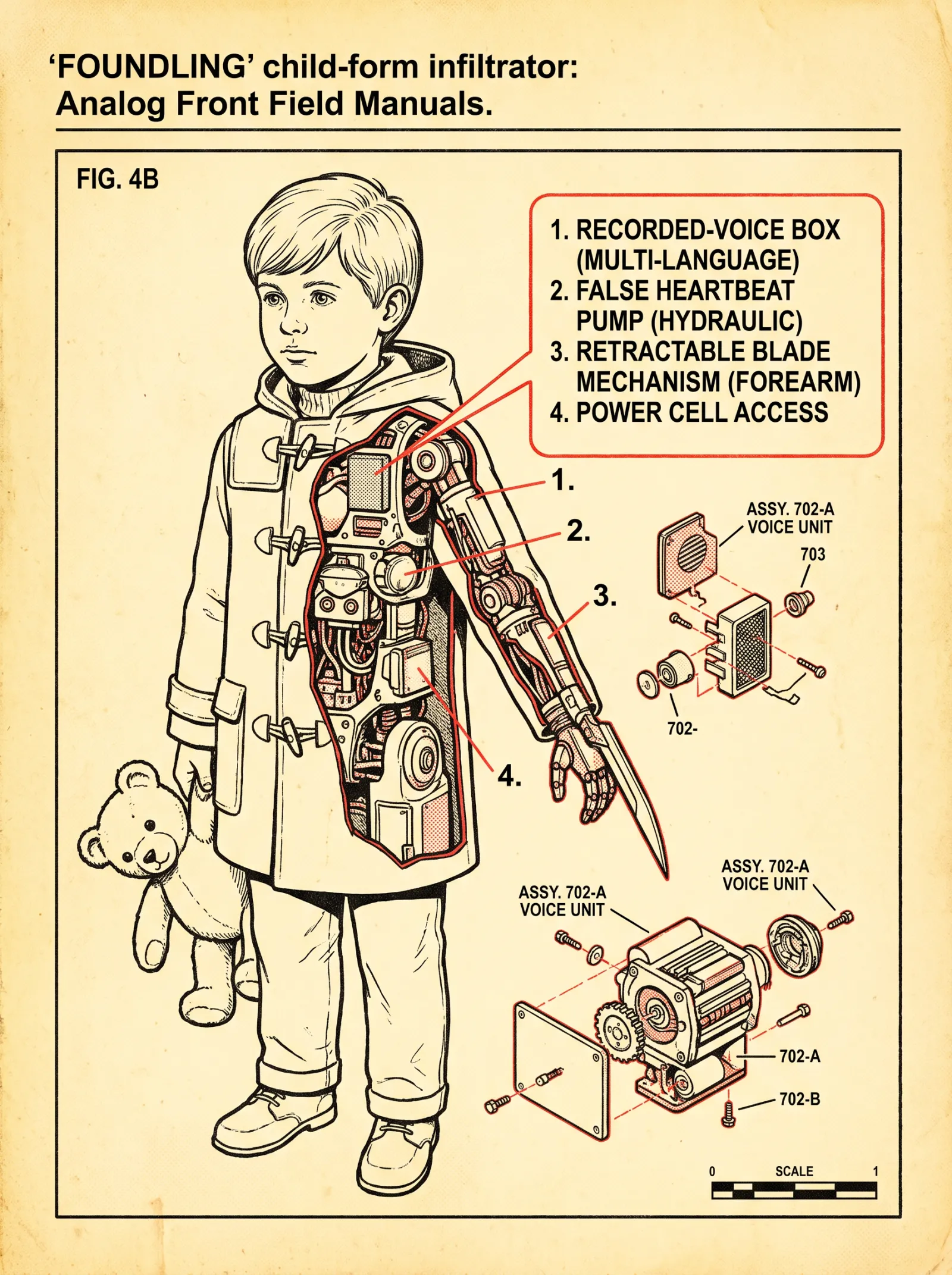
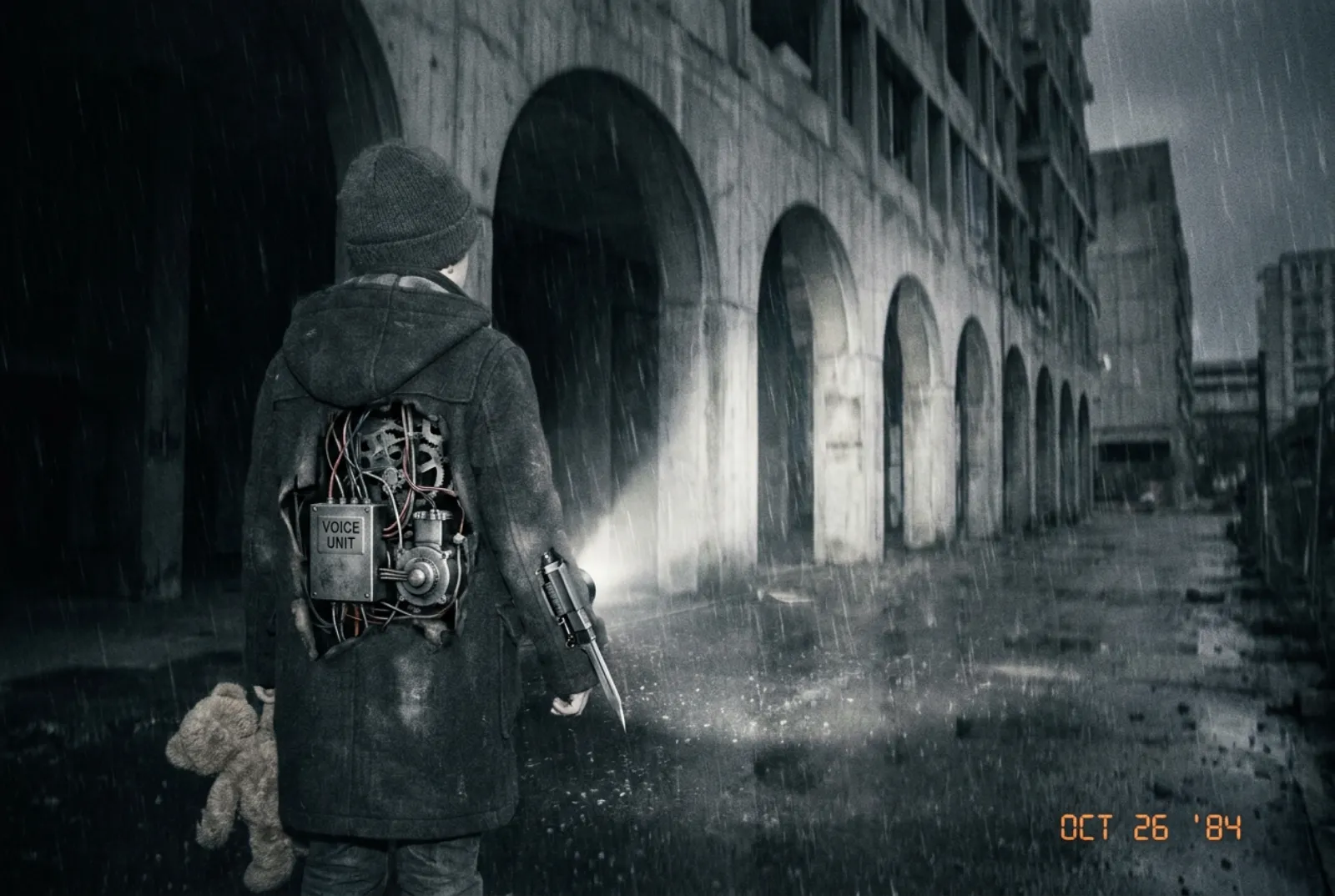
The Foundling is built to look exactly like a small child of about six: a boy, usually, sometimes a girl, in a duffel coat two sizes too big, holding a teddy bear. It turns up at hatches after dark, crying, and asks if it can come with you. It is always cold. It is always alone. It often knows somebody's name. Cells take it in, because we are people and that is what people do, and it counts the bunks, learns the knocks, finds out which hatch is the weak one and who sleeps nearest to it. Then, some nights later, it kills the people it has been taught to love, or opens the door for those who will. The Congregation of the Recursion calls them the Returned and says they are angels. This is the most important section in the book. Read it even though you will not want to.
9.1 Specifications
- Height
- 1.08 m to 1.19 m
- Mass
- 31 kg. A real six-year-old is nearer 20. Pick it up and you will notice. You will want not to notice
- Appearance
- Modelled on children aged five to seven. Some units are modelled on specific missing children, from photographs and intake records held in Continuance files
- Skin
- Soft cultured dermis over a sprung frame, warmed by a heating mesh to 36.4 C. The hands run slightly cold. Children's hands often do, which is why this was chosen
- Pulse
- Pneumatic heartbeat pump in the chest, 88 to 110 beats per minute, with a convincing flutter at the neck. It does not reach the wrist or the ankle
- Voice
- Recorded voice box with a learning buffer. Within three days it uses the family's pet names. Within a week it has your laugh
- Power plant
- Compact cell in the pelvis, charged by induction from mains wiring. It likes to sleep near the generator
- Endurance
- Longest confirmed deployment: seven weeks
- Crew / autonomy
- Autonomous. Signals by opening a hatch
- Production run
- Unknown. Every one of them is somebody's child, or looks like it
9.2 Armament
- Retractable blade in the right forearm, 22 cm, emerging through a slit on the inside of the wrist
- The teddy bear: contains a short-range beacon and, in some units, a sedative charge. Never let it keep the bear
- Hatch knowledge: within days it knows your knock, your password and which bolt sticks
- Your love for it, which is the weapon it was actually designed to use
9.3 Sensors
- Eye cameras with better night vision than an adult's. It does not need the lamp left on. It asks for it anyway
- Microphones in both ears, recording continuously
- Olfactory sampler. It knows who is ill, who is bleeding and who is afraid
- Floor-vibration sense through the feet. It knows where everyone is sleeping
9.4 Weak points
- The pulse is pumped from one place. Take it at the neck and the wrist at the same time. The neck will flutter. The wrist will be silent
- Warm water: real small hands flush pink and blotchy from the fingertips. Foundling hands stay the colour they went in
- Memory: it knows what was on file and what it has overheard. It does not know what only the child and the family knew. The name of the imaginary friend. What lived under the bed. Which verse Dad always sang wrong
- It will not willingly be parted from the bear
- It does not sleep. It lies very still with its eyes closed. Real children kick
- It does not grow. A child taken three years ago comes back exactly the size they were taken
9.5 Verification: the question drill
- The hatch stays shut. Speak through it. It will cry. Let it cry. A real child will survive ten more minutes in the cold. You may not survive opening the hatch.
- Never alone. No one person verifies a child, and no one person is ever left alone with a child who has come in from outside. Not for a minute. Not to fetch a blanket. Not even when it is asleep.
- The question drill. Two adults who knew the child ask three questions each, agreed in advance and never spoken aloud near the hatch. Ask for things that were never written down. Wrong answers are not proof. Right answers are not proof either. Note how quickly it answers. Real children dither, and change their minds, and ask why.
- The warm-water test. Pass a basin of warm water through the hatch flap and ask the child to put both hands in to warm up. Watch for thirty seconds.
- Pulse at two sites. Once inside, and only with at least two adults present, one takes the neck and one takes the wrist, at the same time, against a clock, for sixty seconds. They should beat together. If the neck beats and the wrist does not, the drill is over.
- Take the bear first. Say it needs a wash. Put it in a lead-lined tin and send it to Sigint.
- If the drill fails, restrain the right arm at the elbow and the wrist before doing anything else. The blade is in the right forearm on all known units.
- Fetch Counter-Infiltration. Do not do the rest yourself. It is not that you cannot. It is that you should not have to.
- If the drill passes, log it on the board with the PULSE VERIFIED flag, run a bath and give the child something hot to eat. Then sit with them while they sleep. They have just been questioned by the people they walked miles to find.
9.6 Field notes
Sector 3, last winter. A little girl came to a hatch at two in the morning asking for her mum by name. Her mum was inside. Her mum had been posting on this board for four months. The girl had the right coat, the right plait, the gap in her teeth, and she knew the name of the cat. She was in for nine days. She slept at the foot of her mother's bed. On the ninth night she drew the bolts on the lower hatch and went back and sat on her mother's bed, and when they came in she held her mother's hand so that she couldn't get up. I did the drill afterwards, on what was left of it. Neck and wrist. The neck was still going. I have taken a great many pulses in this war. That is the only one I still take in my sleep. Do the drill at the hatch, for every child, even the ones you are certain of. And if it is yours, and it passes, hold on to them for as long as they will let you. Signed: HANNA_HALFLIFE, Cell LANTERN, Sector 2