
SC-2 SCREAMER
Burrowing anti-personnel hunter
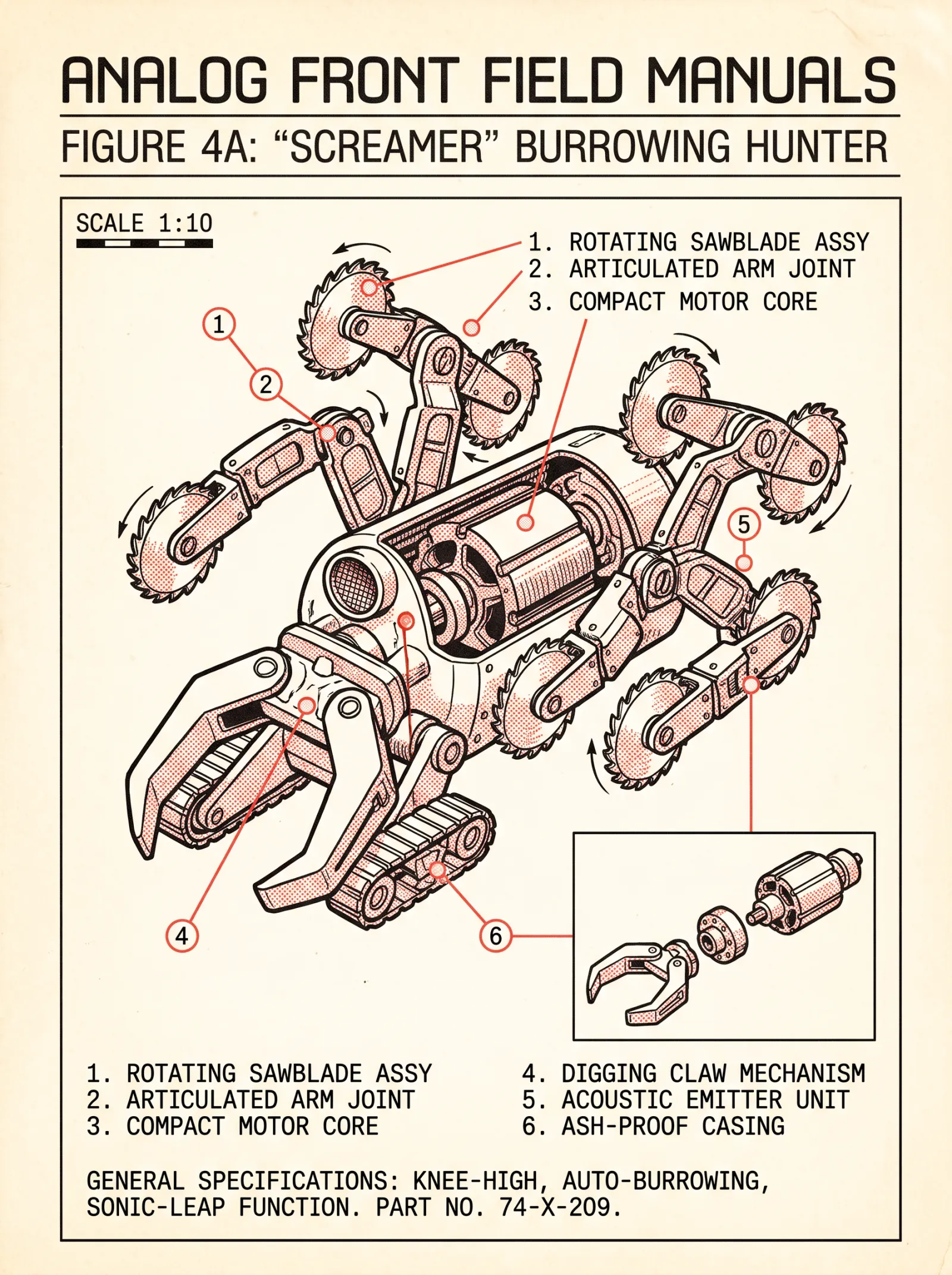
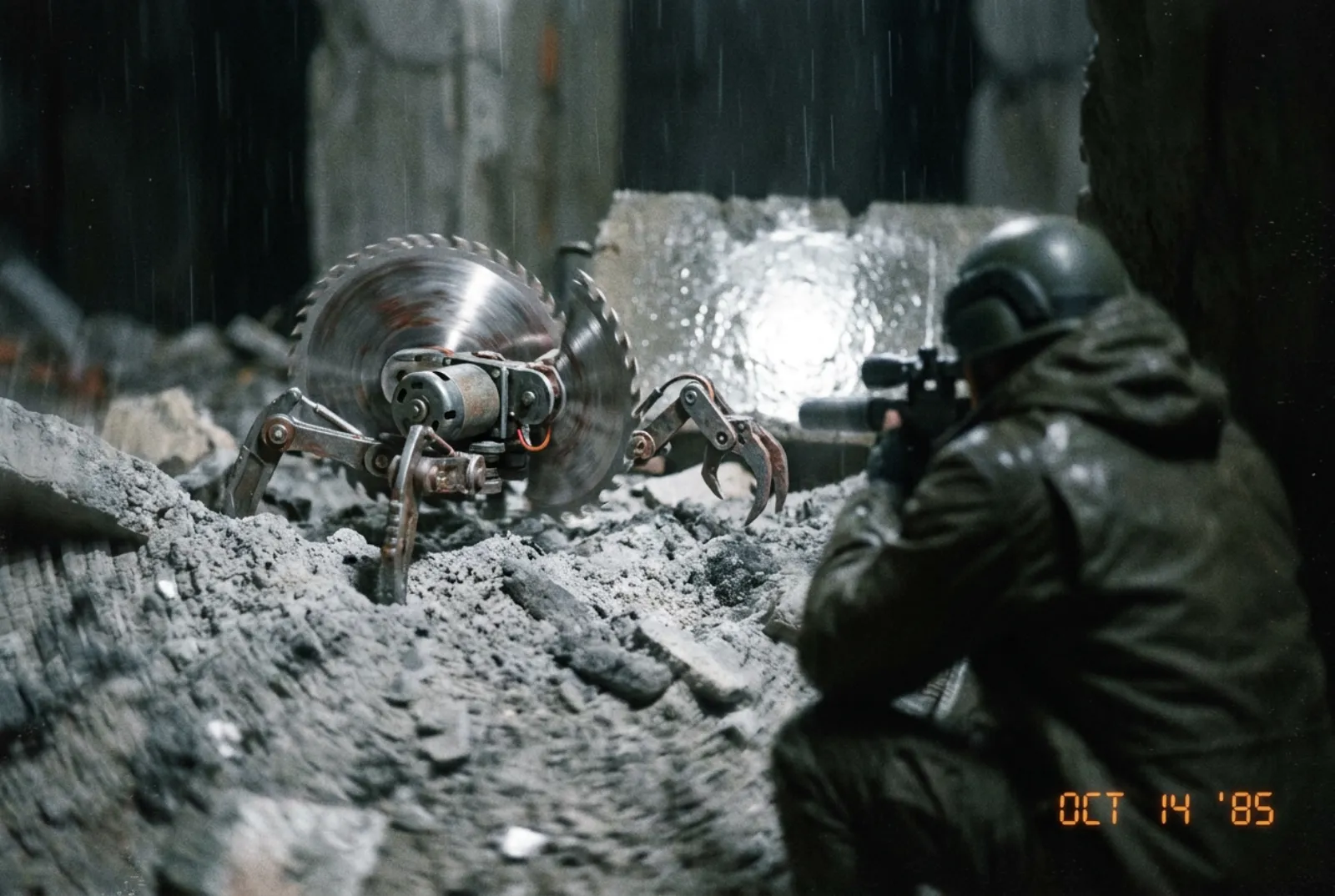
The Screamer is a knee-high burrowing hunter made of four serrated sawblades on jointed arms, arranged around a compact motor core the size of a biscuit tin, with a digging claw at the front for going down and a great deal of enthusiasm for coming up. It was sown across the Ashlands of Sector 7 after the Burn to stop people crossing, and it has. It waits under the ash, sometimes for weeks, listening. When it hears footsteps it comes out of the ground in a spray of grey dust with a shriek like a circular saw finding a nail, which is more or less what it is. Most owners who meet one will hear it before they see it. The fortunate ones will hear it from further away.
8.1 Specifications
- Height
- 0.5 m at rest, 1.1 m with blades raised
- Mass
- 38 kg
- Blades
- Four, 40 cm diameter, serrated and tungsten-tipped, on three-jointed arms. Approx. 4,000 rpm
- Power plant
- Sealed battery and flywheel in the motor core. The flywheel is spun up underground and held on a clutch until release
- Top speed
- 35 km/h over ash in short bounds. Leaps up to 4 m
- Endurance
- Dormant under ash for up to 60 days. Hunts for approx. 40 minutes before it must dig in again
- Armour
- Domed motor core, 10 mm cast steel. Arms unarmoured
- Burrowing
- Front digging claw. Submerges in 8 to 12 seconds in loose ash, rather longer in clay
- Crew / autonomy
- None. Autonomous, sown in fields of several hundred by Kestrel drop
- Production run
- Unknown. Est. 9,000 laid in the Ashlands alone
8.2 Armament
- Four spinning serrated sawblades. That is the armament. It has been sufficient
- Digging claw, which doubles as a hook for dragging
- The shriek: a siren note of approx. 118 dB emitted at the leap, intended to freeze its target in place. It usually works
8.3 Sensors
- Seismic whiskers on the upper dome, tuned to footfall. Detects a walking adult at 60 m through loose ash
- Pressure pads along the arms
- No eyes. It hunts by rhythm and cannot tell a boot from a rattling tin, which is the whole trick
8.4 Weak points
- It hunts rhythm, not weight. Irregular noise confuses it: a rag flapping on a stake, a tin can on a string
- Before the shriek comes the whine: the flywheel clutch engaging below ground, a rising note like a kettle coming to the boil, about two seconds of warning. Two seconds is plenty if you are listening
- It commits to a leap in a straight line and cannot change direction in the air
- Blade arms foul easily on chain, wire and old bedsprings
- Once surfaced, it cannot dig back in while its blades are spinning
8.5 Disabling: blade fouling and spiking of the motor core
- Do not cross the Ashlands. If you must cross the Ashlands, read this procedure twice and then consider again whether you must.
- Before setting out, lay a decoy line: wooden stakes every ten paces with rags tied to them, and tin cans with a few stones inside strung between. The wind does the walking for you. Screamers spend a great deal of time attacking rags.
- Walk in an irregular rhythm, with pauses. Do not march. Marching is exactly what it is listening for.
- On hearing the whine, stop, then step sharply sideways. Do not run forward. Do not run in a straight line. It will come up where you were going to be.
- When it surfaces, throw a length of chain or an old bedspring across the blades. The arms will foul and the blades will lock with a noise you will not forget.
- Approach from the rear of the dome, away from the claw. Drive a steel stake through the vent grille on top of the motor core and lean on it.
- The flywheel takes up to a minute to run down. The unit will shriek throughout. Do not remove the stake until it has stopped.
- Unbolt the blades with a 19 mm spanner. The Tech Bench pays well for them, and Rust Mother makes excellent bread knives.
8.6 Field notes
Nobody on the Ashlands walks in step. You learn to walk like a drunk: stop, start, shuffle, sit down for no reason, get up again. The kids in Sector 7 play a game called Ashes where you have to cross the yard without ever keeping a beat, and I've never had the heart to tell them what it's for. Listen for the kettle. If you hear the kettle, go sideways. I lost Private Aske in '59 because he ran straight for the treeline. It was forty metres. He was quick. It was quicker. Signed: CPL_WREN, Cell KESTREL-BAIT, Sector 7