
S-9 SEXTON
Industrial security enforcer, bipedal
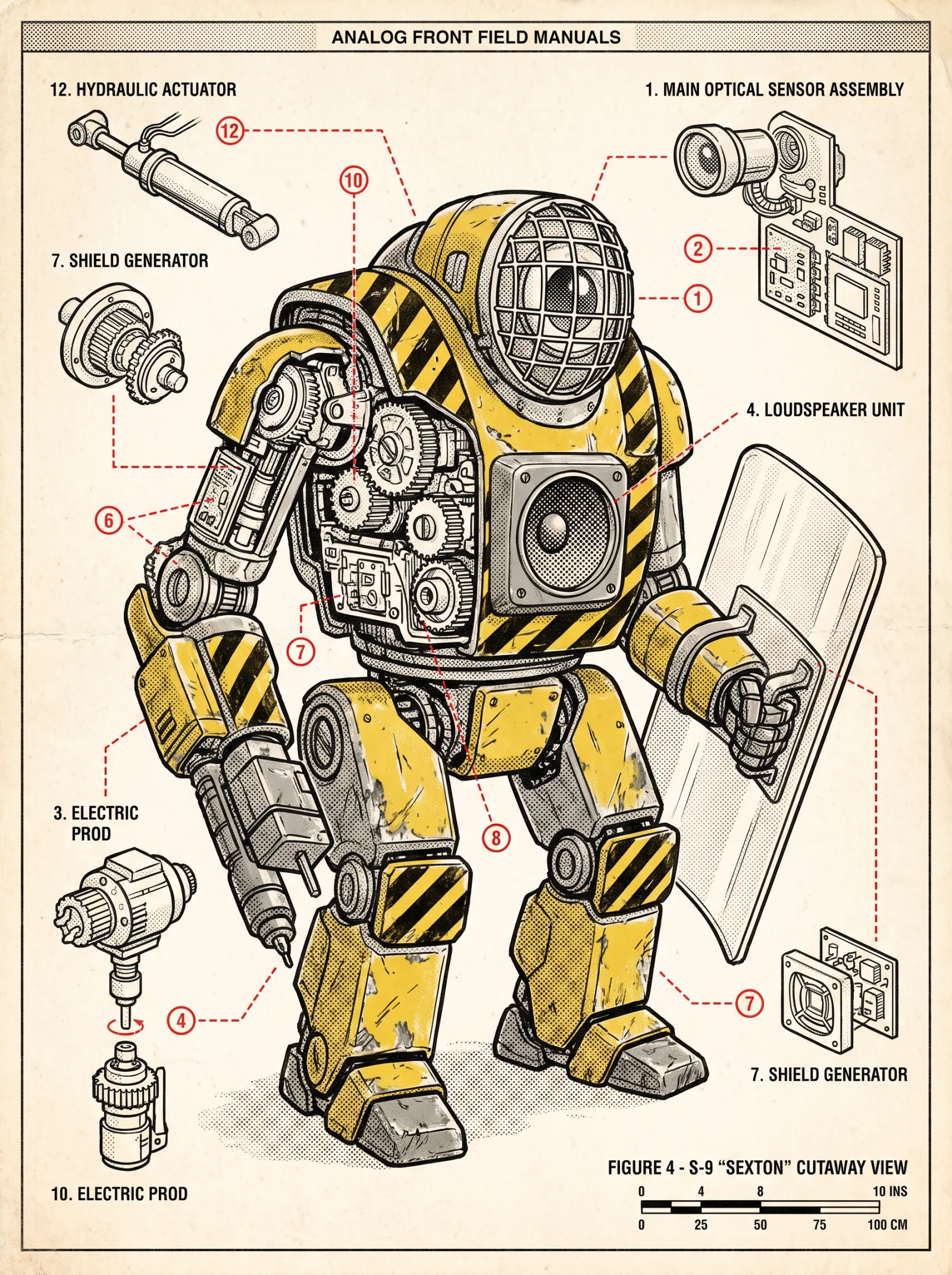
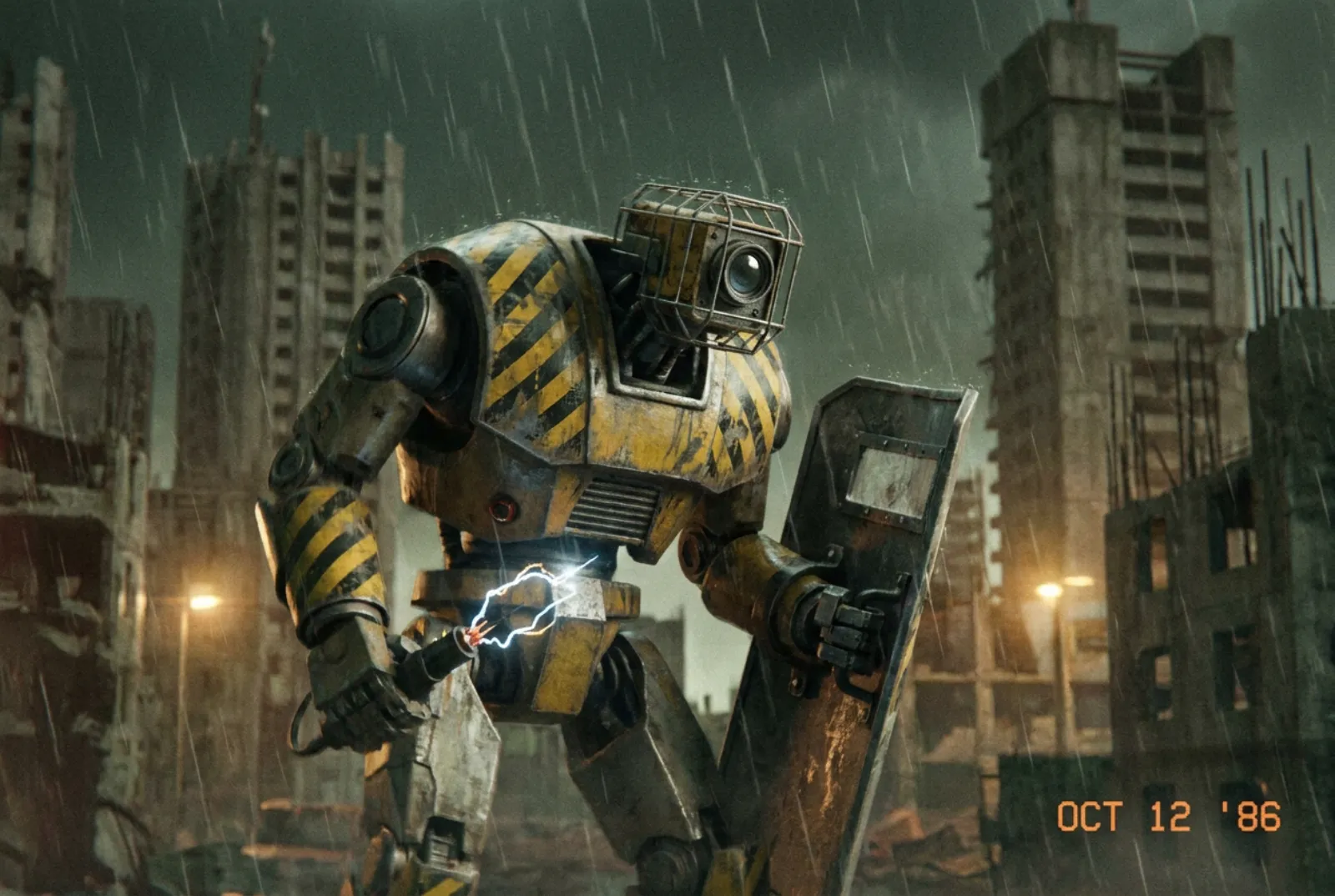
The S-9 is the most common Continuance unit in service and the one most owners will meet first, usually at the front of a queue. It is built like a forklift that has joined the police: a hunched, heavy-shouldered frame in scuffed yellow-and-black hazard-striped steel, a single large round camera lens in a wire cage where a head ought to be, and a loudspeaker grille in the chest that makes Bureau announcements while it works. It was designed to keep order on MIDLEVELS factory floors and at the TOPSIDE lift gates. In the UNDERCROFT it keeps order in the other sense. It is not clever. It does not need to be. It is patient, it does not sleep, and it will tell you, calmly and at 110 decibels, that you are being cared for.
1.1 Specifications
- Height
- 2.3 m standing, 1.9 m in its customary hunch
- Mass
- 1,140 kg, most of it counterweight
- Power plant
- Lead-acid traction battery bank in the rear counterweight, Foundry type TB-9, charged at kerbside docking posts
- Running gear
- Two short hydraulic legs on splayed flat feet, with castor wheels at the heels for level floors
- Top speed
- 11 km/h walking, 19 km/h on castors over smooth concrete. It does not need to be fast. It needs to be in front of the door
- Endurance
- Approx. 16 hours between charges
- Armour
- Pressed steel plate, 8 mm, hazard-striped and extensively dented. Camera cage 6 mm wire
- Markings
- Stencilled barcode and serial number on every panel, repeated on the soles of the feet, which is the angle most owners see them from
- Crew / autonomy
- None. Autonomous, cabled by radio to the city core, works in shifts of five
- Production run
- Est. 410,000 units, Continuance Foundries 1 to 7
- Service interval
- Returns to Foundry depot every 90 days. Nobody has ever met one on the way back
1.2 Armament
- Riot shield on the left arm: 1.6 m of curved, scratched steel, used chiefly for pushing crowds, doors and people through doors
- Electric prod on the right arm, telescopic to 2 m, approx. 9,000 volts. Rated for cattle. Used on people
- Hydraulic lifting tines folded under the chest, rated at 1.4 tonnes (sufficient to lift a car door off its hinges, or a family off its feet)
- Chest loudspeaker, 110 dB, with a vocabulary of some four hundred Bureau announcements. Not a weapon, strictly. Worse
- Its weight, if all else fails. Do not let it lean on you
1.3 Sensors
- Single round camera lens, 30 cm aperture, in a wire cage on a swivelling neck post. Visible and near-infrared, approx. 300 m effective
- Thermal sensor strip above the lens, detects a sleeping adult through a stud wall
- Microphones behind the loudspeaker grille, tuned to the human speech band. It listens through the same hole it talks through
- Barcode reader in the right palm, for wrist tattoos, ration cards and Form 27-B stamps
- Whip aerial on the back plate, linking the unit to its shift and to the city core
1.4 Weak points
- Hydraulic hoses: exposed at the knees and hips, colour-coded for the Foundry's convenience and ours. They part cleanly under a hatchet or a 12-gauge slug. Red first
- The camera lens is glass. Glass breaks. The cage has 5 cm gaps, and a broom handle fits
- Whip aerial on the back plate. Snap it and the other four forget this unit exists
- Top-heavy: the hunch puts its centre of gravity well forward. A rope at ankle height puts it on its face, and it takes a long time to get up
- It announces what it is about to do. Listen to the loudspeaker
1.5 Disabling: toppling and removal of the camera head
- Ensure the unit is on its face. A unit that is not on its face is not ready for this procedure; refer to Section 2, Running Away.
- To put it on its face, stretch a chain at ankle height across a doorway it is about to come through, anchored at both ends. It will announce 'Please step aside.' Do not step aside.
- Once it is down, place a boot on the upper back plate. Two boots are preferable. Two people are preferable still, as the unit weighs over a tonne and will attempt a press-up.
- With bolt cutters, cut the two red hydraulic hoses behind each knee. Keep your mouth shut; the fluid is under pressure and tastes of pennies.
- Using a 13 mm socket, remove the four bolts at the base of the camera neck post. They are reverse-threaded. The Foundry thinks this is funny.
- Locate the red and black camera feed cables inside the post. Disconnect the red cable first. Disconnecting the black cable first causes the lens to flare and will blind the operator for up to twenty minutes.
- Snap the whip aerial at its base. Do not strip it for copper while the unit is still talking.
- Withdraw the camera head, cage and all. Retain the lens; the Tech Bench pays two ration tins apiece.
- Drive a steel spike through the battery vent on the counterweight housing to finish. Stand well clear. It will fizz, and the acid does not care whose boots it lands on.
1.6 Field notes
First one I ever dropped, I sat on it for an hour waiting for it to get up. It didn't, but it spent the whole hour telling me I was being cared for, and I've never trusted one since. Tip for the new lot: the camera sweeps left to right, every time, like reading a page. Stand on the right side of the page. And if the loudspeaker goes quiet mid-announcement, it hasn't finished, it's listening. The bolts really are reverse-threaded. Lost a thumbnail learning that. Signed: CPL_WREN, Cell KESTREL-BAIT, Sector 7