
HK-A KESTREL
Aerial hunter-killer, VTOL
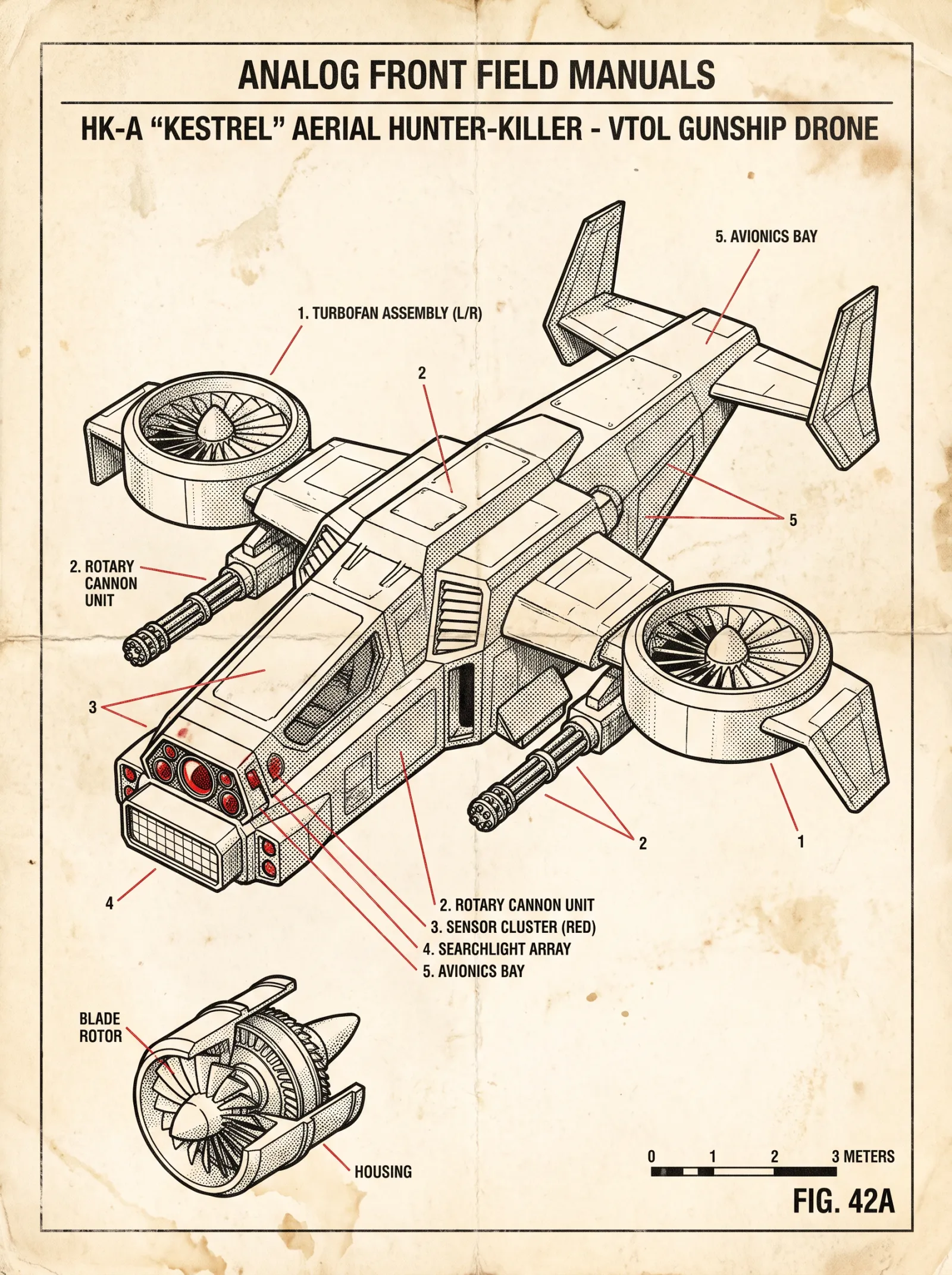
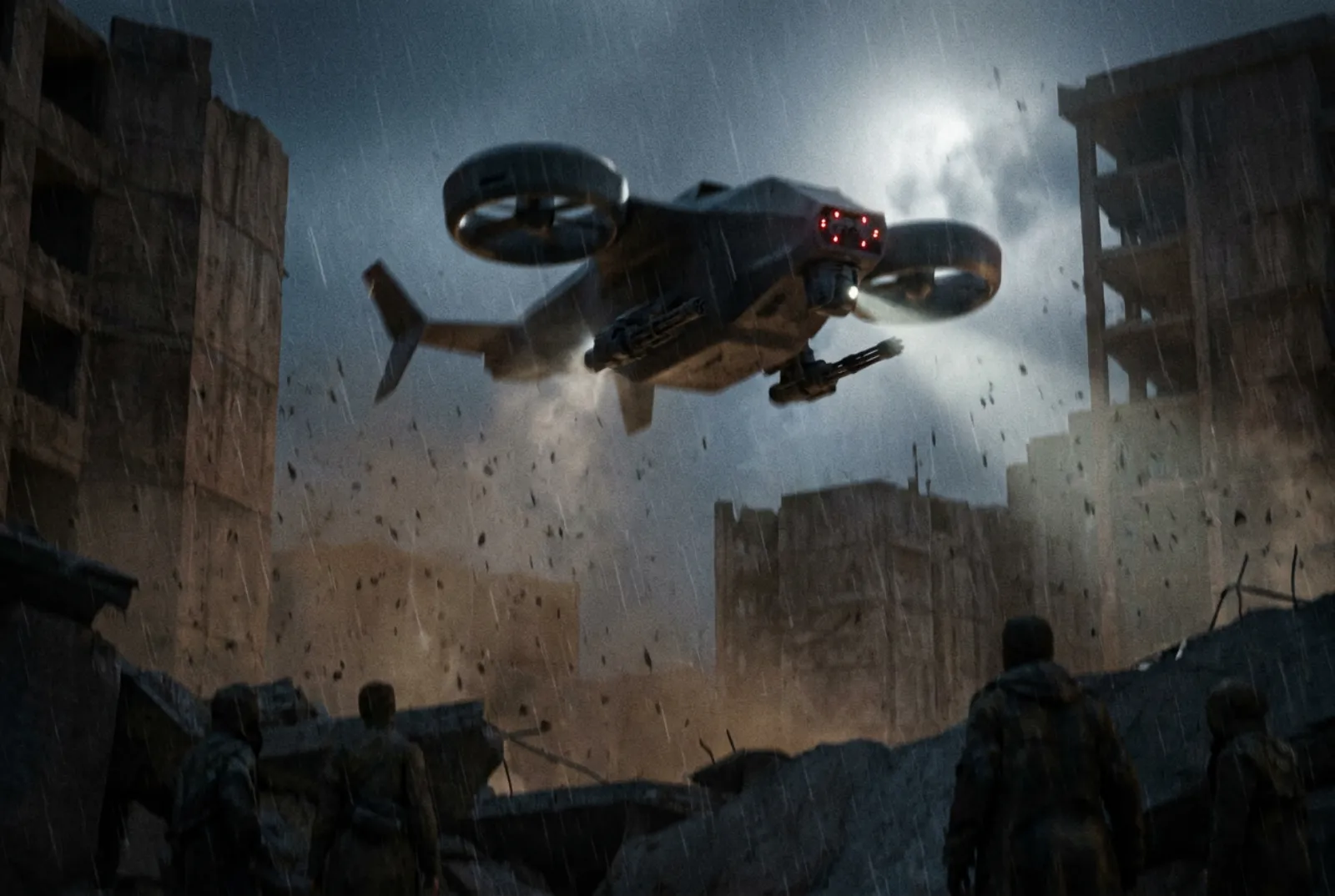
The HK-A is an angular vertical take-off gunship built around two ducted fans and a pair of rotary cannons. It patrols at low altitude with twin searchlights and is responsible for most curfew-hour casualties across all twelve sectors. The owner should note that the searchlights are not for the Kestrel's benefit. They are so that you know it has seen you.
2.1 Specifications
- Length
- 11.2 m nose to tail boom
- Span
- 8.6 m across fan nacelles
- Mass
- 6,800 kg loaded
- Power plant
- Twin Foundry turbo-electric drives, one per ducted fan
- Top speed
- 310 km/h level, hovers indefinitely
- Endurance
- Approx. 9 hours between depot returns
- Ceiling
- Operational 20 to 400 m, rarely seen above 600 m
- Armour
- Composite belly plate, 18 mm. Upper surfaces barely skinned
- Crew / autonomy
- None. Autonomous, tasked by Archivist nodes
- Production run
- Est. 22,000 airframes
2.2 Armament
- Twin 20 mm rotary cannons in chin turret, 360-degree traverse
- Wing-root pods for eight anti-personnel rockets
- Optional loudspeaker for curfew announcements (Optispeak only)
- Downwash, which at hover height will strip the roof off a lean-to
2.3 Sensors
- Twin gimballed searchlights with integrated thermal imagers
- Belly-mounted radio direction finder, which is why you keep your set switched off
- Wide-band microphone array on tail boom
- Ground-mapping radar, 2 km radius
2.4 Weak points
- Fan intakes: the ducted fans ingest debris poorly. A bin bag of scrap chain thrown upward does wonders
- Upper surfaces are lightly armoured. Fire from rooftops, never from the street
- The searchlights. They are also its eyes. Shoot the light
- Hover stability: when both fans are loaded asymmetrically it yaws left and takes three seconds to recover
2.5 Disabling: fan intake obstruction and grounding
- Establish a firing position above the Kestrel's operating altitude. A church tower, a crane cab or the roof of a Bureau office are all suitable; the latter is the most satisfying.
- Prepare an intake charge: 4 m of scrap chain, loosely coiled in a hessian sack, with a 30-second fuse charge taped inside.
- Wait until the unit enters hover. It will hover when it has found something. Try not to be the something.
- Drop or throw the charge into the port fan intake. The port fan is the larger target on account of a Foundry fault in the nacelle fairing.
- Take cover immediately. The fan will shed blades radially at high velocity.
- When the airframe has come down, approach from the rear quarter only. The chin turret retains power for up to four minutes after impact.
- Remove the searchlight lenses with a 10 mm spanner (six bolts per lens). Retain the thermal imaging module intact for the Tech Bench.
2.6 Field notes
The downwash is the thing nobody tells you about. It picks up grit and glass and throws it at you sideways, so goggles or you'll never see it coming. We brought one down with a sack of bicycle chain off the old gasometer in Sector 4 and it spun like a sycamore seed. Beautiful, honestly. Then the chin gun woke up and chewed the gasometer for three minutes. Wait the four minutes. Signed: RUST_MOTHER, Cell MAGPIE, Sector 4